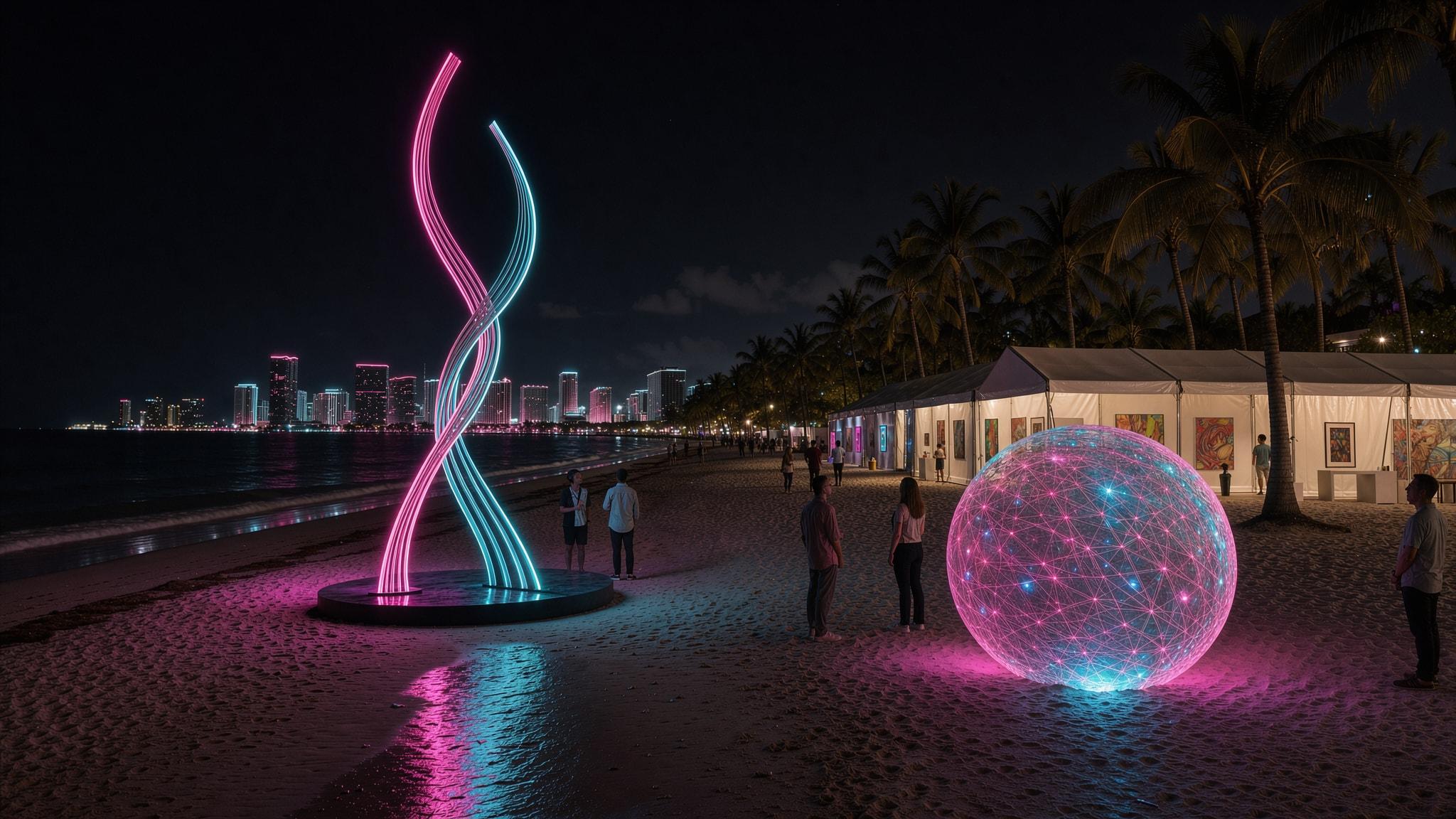
Every December, Miami changes for a week. Traffic on the causeways gets worse, hotel prices go up, every rooftop has an event, and people from all over the world show up at the Miami Beach Convention Center. The reason is Art Basel.
If you live here, you know the week. If you run a business here, you've probably felt it, for better or worse. We're a Miami Beach agency, so we see it from close up every year. Here's what Art Basel is, where it came from, why it carries so much weight in the art world, and what it means for local businesses and entrepreneurs.
What Art Basel Actually Is
Art Basel is an art fair: a marketplace where top galleries from around the world show and sell work by modern and contemporary artists. It isn't a museum exhibition or a festival with a lineup. Galleries apply, a selection committee decides who gets a booth, and the people walking the aisles include collectors, museum curators, artists, critics and a lot of curious locals.
The fair itself runs for a few days. Around it, the city stages what's now known as Miami Art Week: satellite fairs, museum openings, gallery dinners, brand activations and parties from Wynwood to Mid-Beach. Design Miami sets up next to the convention center. Untitled Art puts its tent on the sand by Ocean Drive. NADA, Art Miami and many smaller fairs fill the rest of the map.
How It Started: From Basel to Miami Beach
The story starts in Switzerland. In 1970, three Basel gallerists, Ernst Beyeler, Trudl Bruckner and Balz Hilt, launched an art fair in their city. It grew into the reference event of the art market, the place where serious collectors plan their year.
Thirty years later, the organizers wanted a foothold in the Americas, and they chose Miami Beach. The first edition was set for December 2001 but was called off after the September 11 attacks. Art Basel Miami Beach finally opened in December 2002.
The bet worked. Miami offered things Basel couldn't: winter sunshine, a direct link to collectors from Latin America, and a city happy to throw a party around the fair. The brand later expanded to Hong Kong in 2013 and Paris in 2022, but the Miami Beach edition is still the one most people picture when they hear "Art Basel."
Why It's One of the Most Important Art Fairs in the World
Plenty of cities host art fairs. Few of them move the market like this one. A few reasons:
Selectivity. Getting a booth is hard. Recent Miami Beach editions have hosted more than 250 galleries, chosen by committee. For a gallery, being accepted is a signal of quality. For a buyer, it means the work on the walls has already been filtered.
The people in the room. The world's major collectors, museum directors and curators come to the same place on the same days. Deals, acquisitions and careers get decided in those aisles.
A bridge between continents. Miami Beach has always been the edition where North American, Latin American and European collectors meet. That fits the city perfectly: it is the gateway between the US and Latin America, and it works in English and Spanish every day.
The week around it. The satellite fairs, museum shows and private events turn a trade fair into a cultural moment. Many visitors never set foot in the convention center and still plan their December around Art Week.
What Art Week Means for Miami
Art Basel helped turn Miami from a beach destination into a serious culture city.
The clearest example is Wynwood. A warehouse district became an outdoor gallery and one of Miami's most visited neighborhoods, with the Wynwood Walls, opened in 2009, as its centerpiece. Private collections and museums, such as the Rubell Museum, ICA Miami and the Pérez Art Museum Miami, have given visitors reasons to come back the rest of the year. Every December the city is in front of an international audience that includes wealthy buyers, investors and founders, and some of them come back to stay.
There's also the practical side. For one week, demand jumps across the city. Hotels, restaurants, drivers, event staff, caterers, florists, printers, salons, clinics and real estate agents all feel it. So do the businesses that are trying to keep regular customers happy while the city gets crowded.
What It Means for Local Businesses and Entrepreneurs
Art Week is a big opportunity, and a stress test. The businesses that do well are usually the ones that are easy to reach. Here's what the week tends to look like on the ground.
More inquiries, at odd hours. Visitors message you from their hotel at midnight, between events, or from a time zone six hours away. A med-spa gets asked about a same-week appointment. A restaurant gets a group booking request. A real estate team hears from someone who fell for the city at a gallery dinner. Every one of those is a lead, and leads don't wait.
Many languages. The crowd is international, and a lot of it speaks Spanish. Answering in the language the customer wrote in is the difference between a conversation and a missed sale.
Your regulars don't stop. Your usual patients, clients and customers still need you. If your front desk is buried in new inquiries, someone gets a slow reply, and in Miami that someone books somewhere else.
The follow-up is where the money is. Many of the most valuable contacts aren't ready to buy that week. The collector who looked at condos, the founder who wants to talk about an app, the visitor who might come back in March. Without a follow-up system, those leads go cold by January.
Networking for founders. For entrepreneurs, Art Week packs a lot of investors, founders and potential clients into a few days. Having a working product to show, even a simple MVP, makes those conversations much more concrete than a pitch deck.
How to Get Ready for Art Week
None of this needs a big budget. It needs to be easy to reach, quick to reply and good at follow-up, without burning out your team.
Answer every lead in seconds, in English and Spanish. This is exactly why we built Contestalia, our AI front desk. It replies on web chat, forms, SMS, WhatsApp, Instagram and Messenger, answers only from your own website content, offers real open slots on Google Calendar or Cal.com, and follows up automatically until the lead books or opts out. Your staff can take over any conversation, and everything syncs to HubSpot.
Automate the follow-up, not just the first reply. A short, well-timed sequence after the event keeps your name in front of the people you met while they're still deciding.
Find your bottleneck before the rush. If you're not sure where the week will hurt, our AI Opportunity Audit maps your workflows and ranks the automations by time saved vs. effort. Quick wins first. See all our services.
Founders: plan for next December. If you want something real to show at next year's Art Week, an MVP takes 4–6 weeks with us. Start early, and you'll walk into those conversations with a product, not just an idea. More on our entrepreneur page.
If you're building a company here, it's also worth reading why Miami is becoming a tech hub for AI startups.
Make This Art Week Count
Art Basel brings the world to Miami every December. The businesses that do best are the ones that pick up when the world calls and keep the conversation going after the tents come down.
Want your business to handle the next rush without missing a lead? Book a free 30-minute call and we'll show you where AI can take the busywork off your plate.